
Spring 2026 Research Report from Rezonait
AI visibility, accuracy, and hallucination analysis across 17 sustainable fashion brands on OpenAI ChatGPT and Google Gemini
Executive Summary
When a consumer asks an AI assistant to recommend a sustainable fashion brand, the answer they receive depends on which AI platform they’re using and on whether that platform can accurately identify and reproduce complex sustainability claims. The answers vary widely.
This report presents findings from our audit of 17 sustainable fashion brands across the two AI platforms most consumers actually use: OpenAI’s GPT-4o and Google’s Gemini 3 Flash. Each brand was tested using a layered query methodology that simulates how real consumers discover, evaluate, and compare brands through AI conversation, and how those conversations affect what reaches the point of purchase.
The findings reveal significant gaps in how AI represents these brands. The gaps fall most heavily on the brands whose value depends on nuanced, certified, and verifiable sustainability claims, the brands whose entire commercial advantage is the specificity their customers expect.
For marketing and sustainability leaders at mission-driven brands, the question is no longer whether AI is reshaping product discovery. It is whether your brand’s story is structured for the way consumers are finding it.
Key Findings
The Platform Your Customer Uses Materially Changes Your Brand’s Story
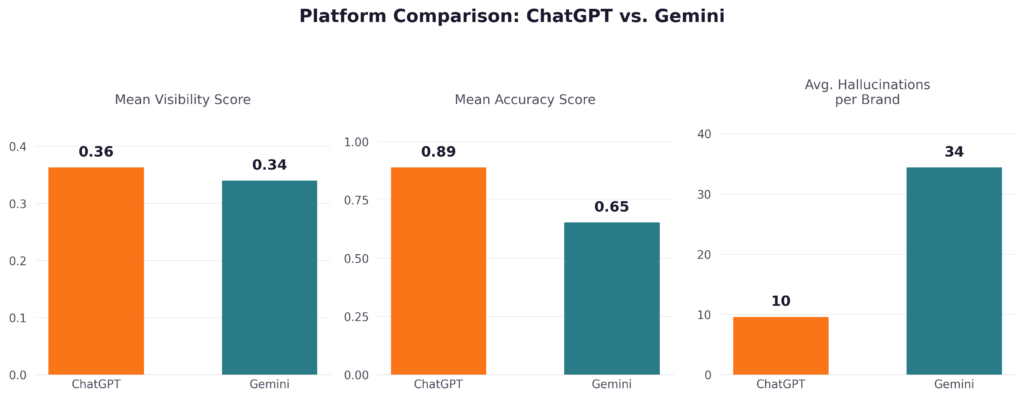
Every brand in the sample received a higher accuracy score on OpenAI than on Gemini. Eight brands scored above 0.90 accuracy on OpenAI. No brand exceeded 0.80 on Gemini. The largest divergence was Harvest & Mill at 0.958 on OpenAI and 0.567 on Gemini, a spread of nearly 40 points. MATE the Label scored 0.329 on Gemini, meaning more than two-thirds of the AI’s claims about the brand were inaccurate or fabricated. For a brand whose identity depends on specific certifications and sourcing practices, that level of misrepresentation is not a minor inconvenience. It is a material risk to the trust that justifies the brand’s pricing.
Gemini Fabricates Brand Claims at 3.6× the Rate of OpenAI
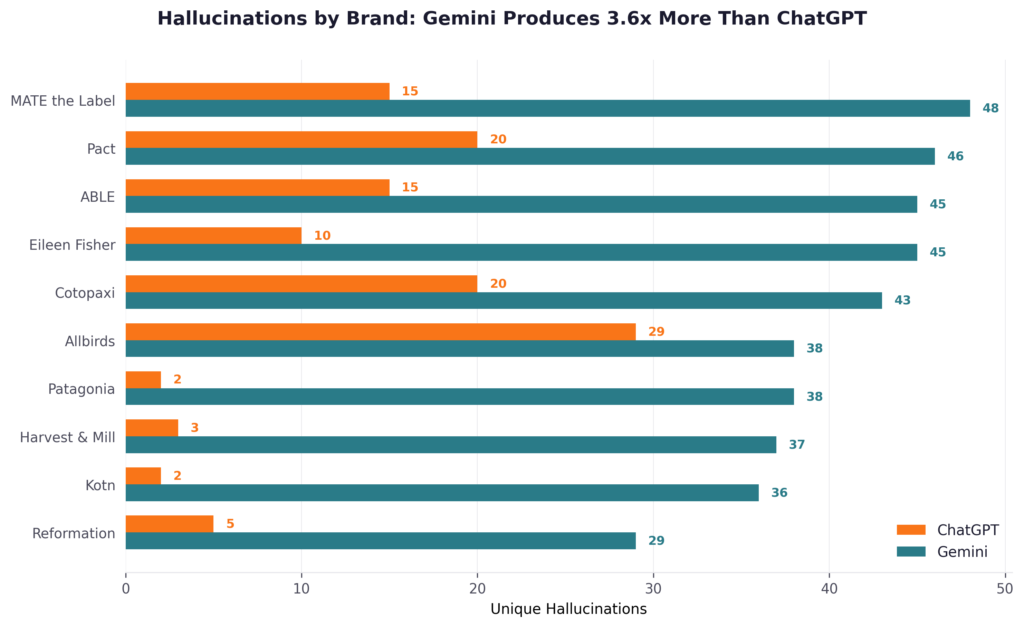
Across the 17 brands tested, Gemini produced 585 unique hallucinations to OpenAI’s 163. The fabrications are not vague. Gemini invented Climate Neutral certification details for Cotopaxi, attributed GOTS certification and B-Corp status to Kotn that the brand has never claimed, and described corporate acquisitions and parent company structures for United By Blue that don’t exist. Three patterns repeat across the data: certification stacking (assigning credentials held by other brands), superlative inflation (taking a partial truth and presenting it as absolute), and staleness (presenting outdated information as current). These are not random errors. They appear systematically across the sample.
Being Seen and Being Correctly Described are Different Problems
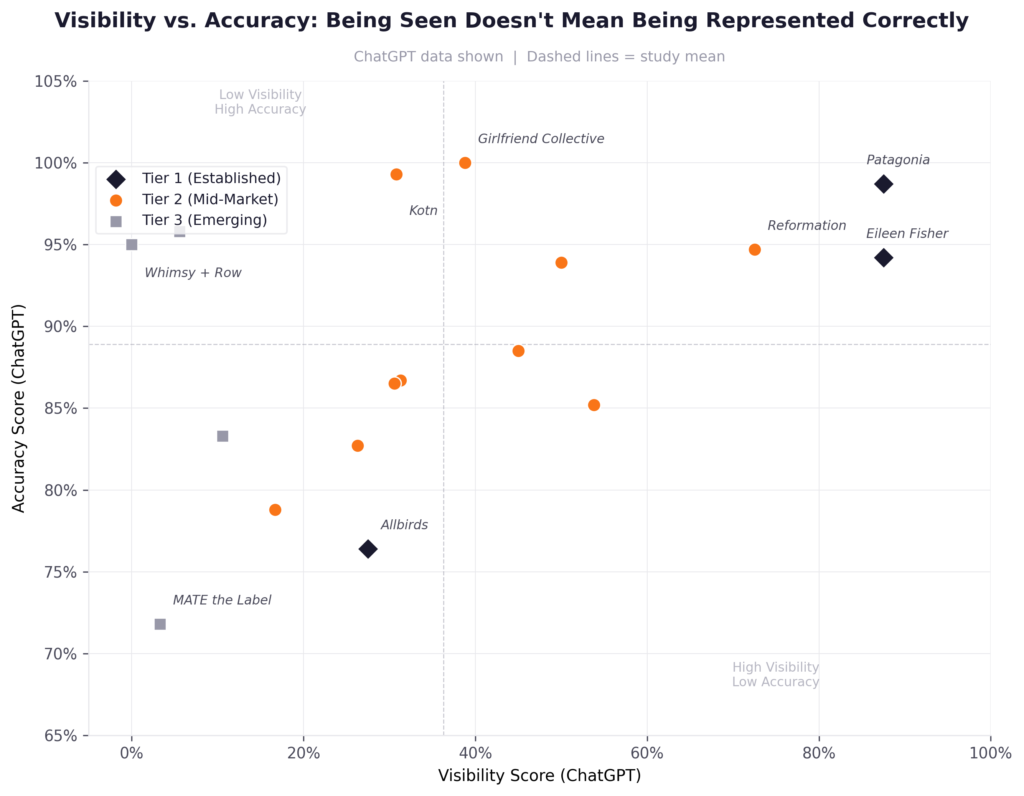
An intuitive assumption: if AI sees a brand, it describes the brand correctly. The data does not support this. Allbirds, a Tier 1 benchmark, recorded the highest hallucination count of any brand on OpenAI (29) and relatively low visibility (0.275). It is well-known and frequently misrepresented. Kotn shows the inverse: its highest visibility (0.783) appears on Gemini, the less accurate platform. On OpenAI, where it would be most accurately described, it appears far less often. Visibility without accuracy is not neutral. It is a particular kind of liability, because consumers receive confident but incorrect information about a brand’s practices.
Brands Disappear During the Purchase Conversation
The audit tested each brand’s persistence across a simulated three-turn purchase journey: from broad discovery to specific evaluation to direct comparison. On OpenAI, three brands never appeared in the first turn. On Gemini, six did not. United By Blue appeared on neither platform’s first turn, meaning a consumer following a natural purchase conversation would never encounter the brand unless they already knew to ask for it by name. This dimension of AI visibility is invisible to single-query testing. It only emerges when the test mirrors how people actually shop.
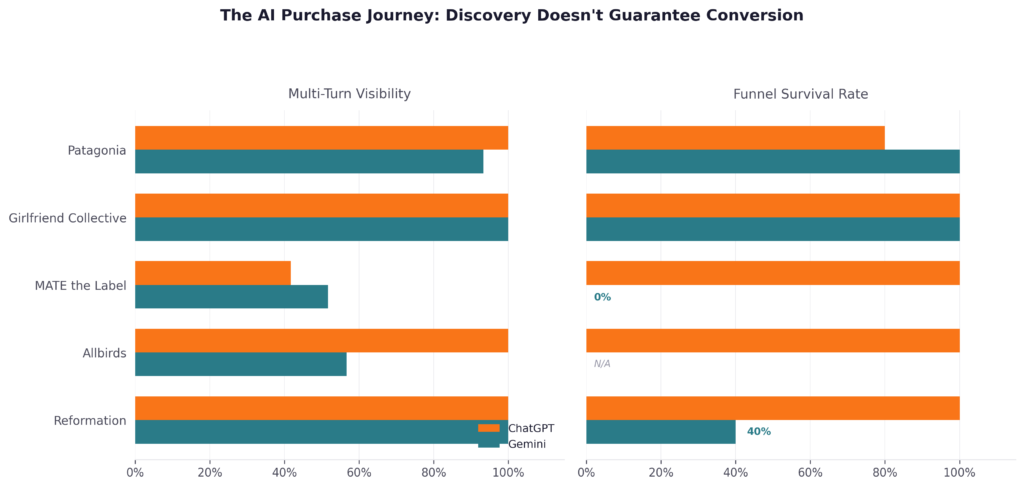
The full report covers all 17 brands, three additional findings, methodology details, and implications for marketing and sustainability leaders.
Methodology
Each of the 17 brands was tested across two AI platforms, OpenAI’s GPT-4o and Gemini 3 Flash. Queries progressed from broad (“best sustainable fashion brands”) through subcategory and niche queries to direct brand verification. A separate three-turn purchase journey simulation tested whether brands persisted as conversations moved from discovery to evaluation to comparison. Every query was run five times to account for the stochastic nature of AI responses. Each brand was profiled against a ground truth fact sheet compiled from the brand’s own published materials and independent third-party sources. To eliminate scoring bias, OpenAI responses were scored by Gemini and Gemini responses were scored by OpenAI. Full methodology, scoring criteria, and brand-level data are in the PDF.
About Rezonait
Rezonait is an AI visibility consultancy for mission-driven brands. We audit how AI assistants represent the brands that compete on certifications, supply chain transparency, and sustainability claims, and we help brands close the gap between what they’ve built and what AI tells consumers about them.
If you’d like to see how your brand appears across major AI platforms or for questions about this report or to request brand-level data, then please reach out to us!