
Field Research & AI Insights
Explore our field research on AI visibility and brand integrity. We publish data-driven insights on preventing AI hallucinations, optimizing semantic data, and ensuring LLMs accurately interpret your mission-driven brand.
-
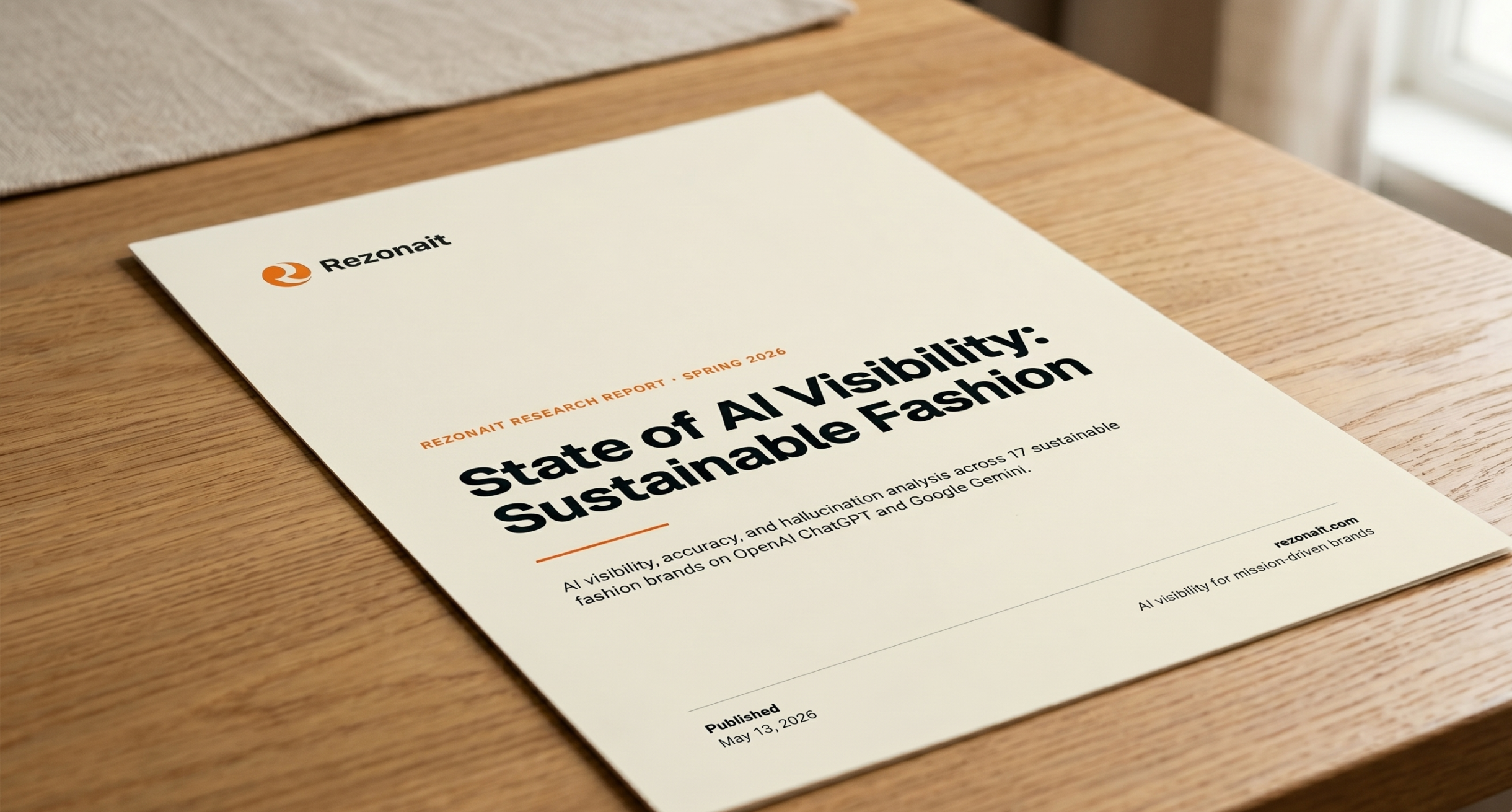
State of AI Visibility: Sustainable Fashion
This report presents findings from our audit of 17 sustainable fashion brands across the two AI platforms most consumers actually use: OpenAI’s GPT-4o and Google’s Gemini 3 Flash. Each brand was tested using a layered query methodology that simulates how real consumers discover, evaluate, and compare brands through AI conversation,…
-

Where the Water Goes
The shift from traditional search to AI-powered discovery has been building for the past two years. But in the span of just a few months — from late 2025 through early 2026 — BCG, Gartner, McKinsey, Adobe, Salesforce, and Forrester each released findings that, taken together, suggest this is no…
-

Ethical Brand Visibility: Closing the Gap for Purpose-Driven Companies
For the last 20 years, the goal of digital marketing for ethical brand visibility was simple: Ranking. If you were on Page 1 of Google, you won. Even if you were result #4 or #5, users would still see your name, click your link, and read your story.
-

AI and Sustainability Reports: Why PDFs Are the Dangerous “Silent Killer” of Visibility
You spent six months and significant budget auditing your supply chain, verifying your carbon offsets, and designing a beautiful 80-page Impact Report. But there is a problem. The standard format for ESG, ethics, or sustainability reports—the PDF—is essentially ‘dark matter’ to Large Language Models (LLMs) like ChatGPT and Claude. When…
-

Monte Carlo Simulation in Marketing: A Guide to Better AI Search Visibility
Most marketing teams consider AI to be a search engine. They type in a prompt—”What are the best sustainable coffee brands?”—and they accept the answer as fact without realizing the value of a Monte Carlo simulation in marketing. If their brand appears, they celebrate. If it doesn’t, they panic.

FAQ
Frequently Asked Questions
From setup to support, here are the answers you need to launch faster with confidence.
How is this different from SEO or Generative Engine Optimization (GEO)?
Standard SEO optimizes for clicks. Whether you call it Answer Engine Optimization (AEO) or Generative Engine Optimization (GEO)—they just want your brand to show up. We optimize for integrity. For ethically minded businesses, “being found” isn’t enough if the AI hallucinates your supply chain data or fails to cite your certifications.
We don’t just try to “rank”; we structure your semantic data so that AI models are forced to describe your mission, sustainability, and ethics accurately.
Why does ChatGPT give different answers when I search for my brand?
Because Generative AI is probabilistic, not a static database.
Unlike a Google search that retrieves a fixed file, AI models generate a new answer every time based on randomness and context. This means your single search is just a “snapshot”—an anecdote, not data.
To see the full picture, our audits run thousands of simulations (Monte Carlo tests) to reveal the statistical probability of how your brand appears across all potential customer conversations, rather than just the one version you happened to see.
How do I fix AI hallucinations and inaccurate data about my company?
We identify the source of the error. Often, AI gets your story wrong because your “truth” is trapped in unreadable formats like PDFs or generic website copy. We fix this by converting your core differentiators—like your Impact Report or B-Corp status—into structured data (JSON-LD/Schema) and submitting them to the Knowledge Graph. This creates digital “guardrails” that guide the AI toward the truth.
Why is AI visibility critical for sustainable and ethical brands?
If you compete solely on price or convenience, standard SEO or GEO tools are likely enough. But if you compete on trust, nuance, or standards (e.g., Fair Trade, organic, locally sourced, ethical labor), this is critical. The more complex your story, the higher the risk that AI will “flatten” or misrepresent it.
Can you guarantee that the AI will always describe my business perfectly?
We deal in probability, not certainty. Because Generative AI is creative, it acts more like an improvisational actor than a database—it will rarely repeat the exact same script twice. Our goal isn’t to script the AI (which is impossible); our goal is to anchor it. By establishing a machine-readable “Source of Truth” for your brand, we make it mathematically far more likely that the AI will retrieve your verified facts (certifications, impact data) rather than hallucinating generic answers.
In other words, we can’t control the dice, but we can help load them in your favor.
Your mission is too important to be hallucinated
Don’t let generic AI summaries flatten your hard work. Join the pilot program today to audit your signal and protect your reputation.